
Traditional Emirati Gold Jewelry: The Legacy of Murta'asha, Tabla, and Tasa
The Symbolism of Gold in Emirati Society
In the United Arab Emirates, gold transcends its status as a precious metal; it is a silent language communicating national identity, generosity, and rich history. Long before the oil boom, Emirati women adorned themselves with heavy, intricate gold pieces that reflected their family's social standing and served as strict economic security ("Zeena wa Khazeena" - Adornment and Treasury).
Traditional Emirati jewelry is crafted almost exclusively from 21k gold (and occasionally 22k) to withstand heavy wear while maintaining the robust yellow hue favored in the Gulf. In this guide, we will explore the most iconic traditional pieces sought after by brides in the Dubai Gold Souk and Sharjah’s Central Souq.
Icons of Emirati Gold
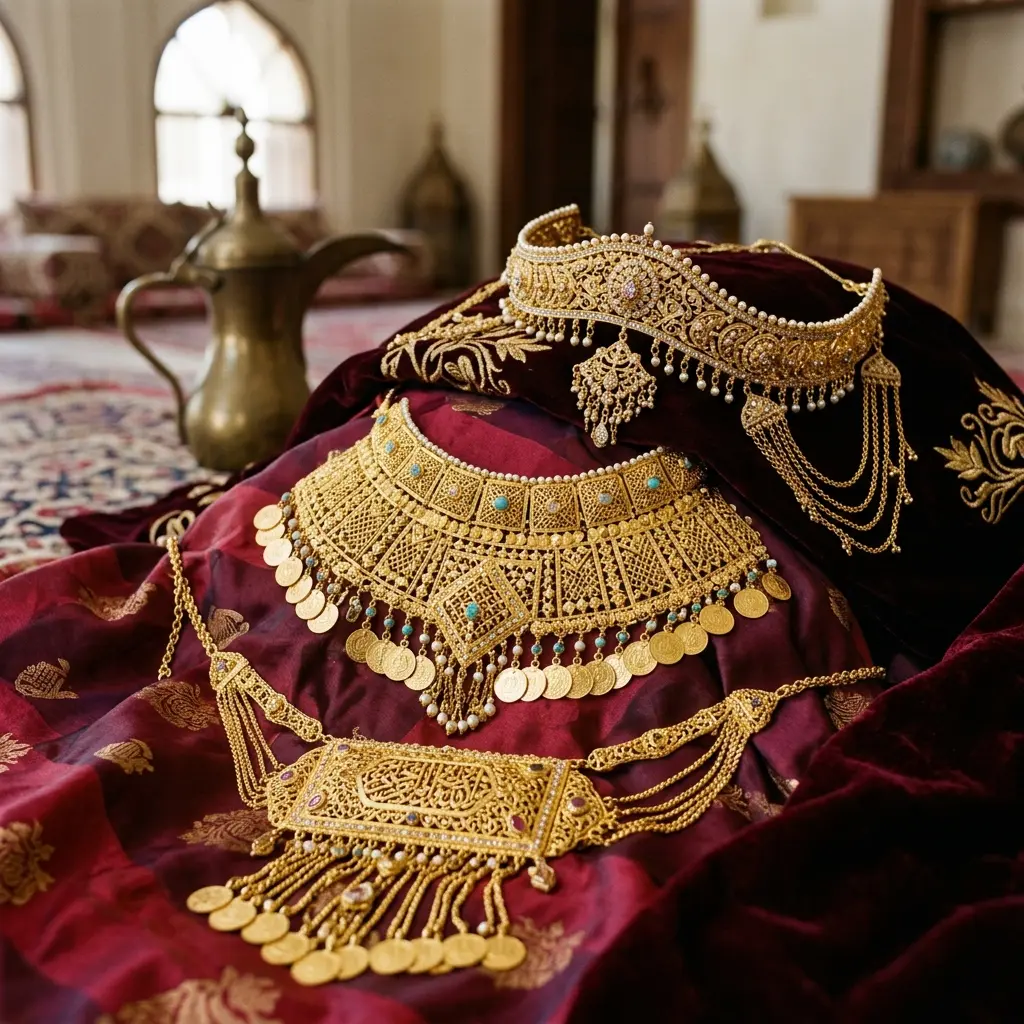
- Al Murta'asha (The Quivering Choker):Arguably the most famous piece. It is a wide choker necklace that wraps tightly around the neck, featuring dozens of cascading small gold chains or square coins that "quiver" (Murta'asha) with the wearer's movement. It is the absolute centerpiece of an Emirati bride's dowry.
- Al Tabla (The Drum Necklace):A long, heavy necklace featuring a massive, central square or rectangular pendant resembling a small drum (Tabla). It is traditionally heavily engraved with Quranic verses or Islamic geometric patterns. Historically, it served as an amulet holder (Hirz).
- Al Tasa (The Headpiece):A luxurious gold headpiece resembling a small skullcap, placed on the crown of the head. Long gold chains cascade from it, covering the hair and reaching down to the shoulders. A traditional Henna night look is incomplete without the Tasa.
- Al Hayoul (Rigid Bangles):Wide, rigid gold bangles stacked in multiples. They often feature spiked or raised studded patterns (Mashawk). Hayoul are bought in large volumes and serve as excellent physical investments due to their lower making charges.
Calculating Prices and Making Charges (Al-Masnaiya)
When visiting the Dubai Gold Souk or Sharjah Central Souq to acquire these pieces, remember that the international Gold Spot Price is fixed by the Dubai Gold & Jewellery Group. You must strictly negotiate the "Making Charge" (Al-Masnaiya).
Because pieces like the Murta'asha and Tasa require incredibly exhaustive manual labor and soldering, their making charges are significantly higher than standard machine chains (often 40-60 AED per gram). Conversely, Hayoul (bangles) carry much lower premiums and can be aggressively negotiated down to 15-20 AED per gram.